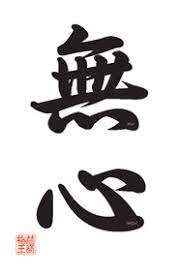
As you may have seen, the recent series in the Aiki Insights program that I run on the dojo YouTube channel is focussed around ‘progressions’, and the principle of mushin (no mind). Having this presence of ‘no mind’ (I hear you say that this sounds like a contradiction in terms, but please let me assure you that its not) simply means to not get too attached to anything. Becoming too attached to something in the moment can lead you to distraction of thought and deafen you to your natural intuition: your intuition is your true self (emotional and behavioural response) based on the physical, ethical and moral ‘training’ or development you have done throughout your life. This can apply to a martial context in the heat of battle or to any other aspect of your life. In this article I aim to explain what I believe to be true about this principle and I’ll call on sections of Gozo Shioda Sensei’s book Aikido Shugyo to illustrate some of the points.
Firstly, let me place this principle in a non-martial context to which we might all easily relate: driving. Have you ever been driving along in your car alone, and before you know it you’ve arrived at your destination and for much of your trip you were oblivious to the journey? You might say that you were in a state of ‘flow’ and your mind was completely empty. You would have seen things and made unconscious decisions that collectively got you to your destination, yet the whole process just happened literally before your eyes. Another example is when you play an instrument. In this you are ‘lost in the music’ playing without thought and acting solely on intuitive emotion – flow. This is something of the sort of principle I am talking about here. But to be able to call on this level of ‘mushin’, or perhaps conscious cognitive mindlessness, at will in any situation is quite difficult. Many people can only call on this ‘flow’ state in calm, relaxed meditation sessions. One way, I believe, to be able to call on this in any state – calm or chaotic – is to practice aikido intensively and consistently over a long period of time. I will now explain why we are lucky to have the experience of aikido in our lives as the key to accessing ‘flow on demand’.
When training in aikido through ‘kata geiko’ (the forms practice or methodology of pre-set sequences) we consistently practice techniques as a means or vehicle to understanding, developing, and absorbing the core principles of aikido: Shuchu ryoku (focussed power), Chushin ryoku (centre line power), Datsu ryoku (the release of power) and Maai (the understanding of distance). After all, the point of our training is to one day transcend the scripted and stylised techniques such as ‘shiho nage’ or ‘ikkajo’ etc. and reach a state where the principles underpin every one of our movements in a natural way both in and out of the dojo. I guess that only once we have achieved this can we act without thinking and say that aikido has finally permeated our body. ‘But this will take years!’, I hear you say. Yes, it will. And, it will not be achieved by everyone, either. I believe it is only achievable for the diligent practitioner who practices for the most part on a daily basis over a long period of time.
Sometimes you hear people say that the technique didn’t work, or you might have even experienced it. Yes, even Gozo Shioda Sensei clearly points out that aikido techniques have their limits and don’t work all the time, even some techniques may not be effective on everyone due to their physiology. But this is ok. To think that a particular technique will always work by doing it the exactly same way again and again is a false claim. Having said this, however, its important not to get hung up on it. When one technique may not work, let it go and move into another by way of natural movement. Jiu waza practice is really the best means to reach this feeling as you can continue moving into other techniques once one has failed or not worked as well as you hoped. In authentic jiu waza you have no time to think, just react. In this way you can move closer to the state of ‘mushin’ and understand that every technique you do at that moment will never be repeated in the same way – the variables of that interaction were unique. Therefore, your response, underpinned by the principles, must be unique too. Its really important that you don’t get hung up and try to force a technique that has failed, move on and let it go. This idea, albeit not necessarily in Jiu waza, is the basis of what I am exploring now in the recent Aiki Insights ‘Progressions’ series.
To illustrate this further, I will ask Shioda Kancho Sensei to explain from his book ‘Aikido Shugyo’ using his experiences training in the Ueshiba Dojo under O’Sensei. Ueshiba Sensei took the approach that ‘You must learn the technique, then forget it!’ so that you don’t tie yourself too closely to a form and build flexibility in your approach to be able to respond in any situation. Interestingly, Shioda Kancho explains how the way to reach this level is paradoxically through the ‘form’ or kata geiko.
‘In those days, [Ueshiba] Sensei would first demonstrate a technique we were to practice, simply giving us an idea of the movements. By no means did he ever explain to us how to do something.
By watching Sensei’s example we tried to work the technique out for ourselves. But no matter what we did, Sensei would be on the sidelines saying only: “Ah! That’s good! That’s good” This was extremely frustrating, however, since we had no idea just what it was that was good! You may think that this was an unkind way of teaching, but Sensei always felt that this is what budo was about.
“Learn it, then forget about it,” was the expression Sensei always used. Let’s take, for example, using shiho nage to throw your partner who attacks with a front strike. The first time you try it, it works fine, and so you try to throw him in exactly the same way the second time. However, this time the force and position of his body, as well as the way he uses his power has changed subtly. So, if you try to move just as you did the first time, your technique will be ineffective.
The proper way is make appropriate changes in your own body movements in response to changes in the opponent. There is no such thing as doing things just one way for each situation. You can’t do exactly the same thing twice. If you ca deal with each individual situation in the most appropriate manner, then your technique will always work. [Ueshiba] Sensei always used to say, “If you can’t grasp this, then you can’t do martial arts.”
Ultimately, “learn it, then forget about it” is not about trying to repeat what you have done before. Rather, it has to do with totally putting preconceptions out of your mind and facing each circumstance as a completely new one, and in this way coming to terms with the technique. Then you can develop the feeling of “seizing the moment” without relying on set procedures (Gozo Shioda, 1991:122-23).
Shioda Sensei goes on to say that, paradoxically, the way to avoid frustration in the training process to achieve this state of mushin and confidence in one’s ability to perform effective techniques when “seizing the moment”, is through attention to detail in the daily practice of ‘forms’ or kata. These are the mechanism for our body to acquire the budo principles, according to Kancho Sensei. So please, join me in this exploration of the journey to mushin through daily kata geiko training in a safe and supportive manner. But please, let go of any preconceived ideas that every technique you practice must always work, or that it should always look and feel exactly the same way with every training partner in every training session. “Learn it, then forget it”, and then start again with a freed and flexible mindset.
Osu!
Ryan Slavin
 Goshu-Ryu SunCoast
Leave a comment