Do you keep a logbook of services for your car?
It’s easy to lose sight of where we have been in our
life and not tend to the maintenance of what we know and are able to do as a result of it. I believe this is because our minds are fixed in the future, not firmly rooted in the present (with mere regard of the past and the future). We often let go of necessary information or skills with the belief that we have ‘done that’ and ‘have moved on’… But how might we ‘move on’ if we can’t provide ourselves with a firm base from which to move on?
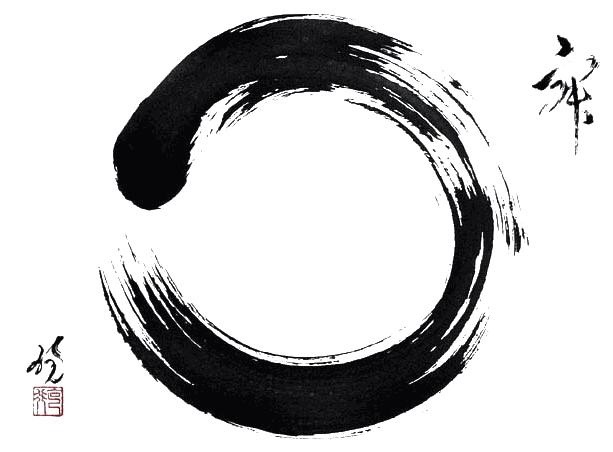
The Japanese circle or ‘ensō’ provides insight into how we may address this. Ensō (circle) is a sacred symbol in the Zen school of Buddhism and is one of the most common subjects of Japanese calligraphy, even though it is a symbol and not a character. Modernzen.org (2025) describe Ensō as the following,
In the sixth century a text named the Shinhinmei refers to the way of Zen as a “circle of vast space, lacking nothing and holding nothing in excess”. At first glance the ancient ensō symbol appears to be nothing more than a miss-shaped circle but its symbolism refers to the beginning and end of all things, the circle of life and the connectedness of existence. It can symbolize emptiness or fullness, presence or absence. All things might be contained within, or, conversely, excluded by its boundaries. It can symbolize infinity, the “no-thing”, the perfect
meditative state, and Satori or enlightenment. It can even symbolize the moon, which is itself a symbol of enlightenment—as in the Zen saying, “Do not mistake the finger pointing at the moon for the moon itself.” In other words, do not mistake doctrines, teachings or explanations, which are intended to guide one toward enlightenment, for enlightenment itself. Ensō can also represent the moon’s reflection on water, thereby symbolizing the futility of searching for
enlightenment outside oneself.
Unfortunately, we look at any endeavour in which we undertake as a linear progression from a
start point to a ‘destination’ in the unknown future, tracing a straight line from beginning to end. And, we often seem fixed on where we think we are going and where we hope to be ‘when we get there’. Yes, progress in martial training is important, but it’s never linear. In fact, all learning is never linear. The ensō shows us that the destination we seek in any endeavour is elusive and unrealistic, and is really limiting if we are constantly focussed on a destination. If we don’t circle back constantly to where we started or to intervals of significant learning regularly, our arc of understanding never really expands, and wisdom (or insight from depth of knowledge) from our endeavour cannot be gained.
Have you been working with a junior belt on something and perhaps forgot what to do or how to
help them with something seemingly fundamental? Or, have you worked with a junior belt on a
technique that you feel you know, yet you haven’t been able to make it work? Chances are your mindset has been fixed on a linear learning trajectory, and you haven’t been open to revisiting (circling back) to that which you believe you already know with fresh eyes and a beginner’s mind.
So don’t dismiss what we think we know as learnt. Every interaction is unique, and every uke’s body is unique, therefore, every technique we do has only one chance of learning from it… Once that’s done, the next time is completely new again! Revisit and repeat, and I believe over many years our bodies will learn profoundly and we will perform free of our minds lead. Happy training!
Osu!
Ryan Slavin
 Goshu-Ryu SunCoast
Leave a comment