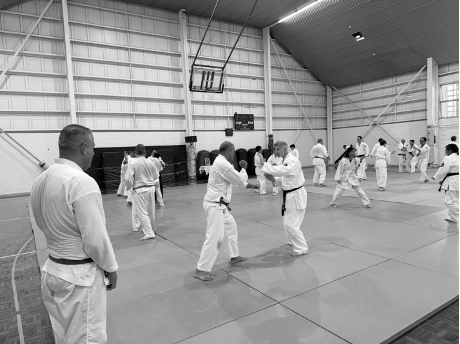
What a great weekend of training! Mori Sensei was extremely satisfied with the quality of the venue and the participation rate of our student body. Well done everyone!
After discussing and planning the structure of the 2-day camp with Sensei over dinner on the Friday night prior to the commencement of the camp, it became clear that our GRAJJ community was in for a fabulous weekend of training. And by all accounts afterwards when speaking to students, everyone thoroughly enjoyed both the training and the communal interaction with the extended GRAJJ family.
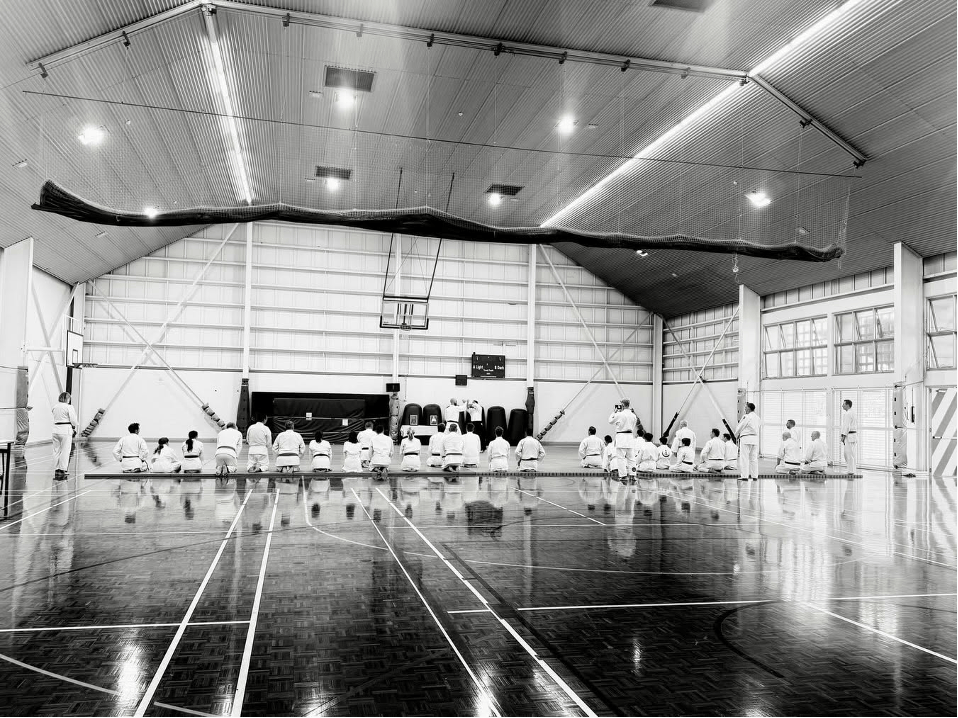
The first day was a big one! We trained in 4x 1.5-hour sessions covering the GRAJJ Shite Waza syllabus. It was a wonderful opportunity to receive fine-tuned advice on these techniques developed and refined by Mori Sensei over the past 35 years training with Australians as he built the Brisbane Dojo.
DAY 1
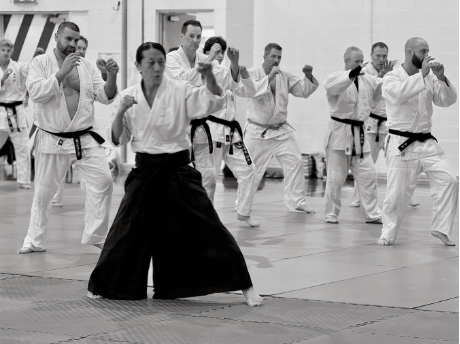
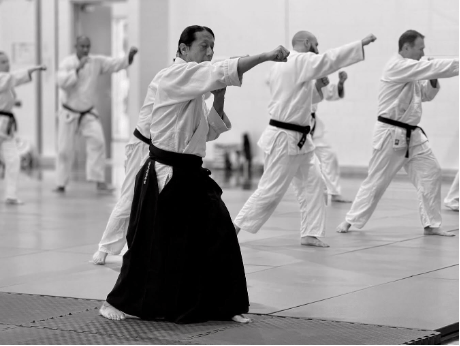
We began the day in Session #1 with Taisabaki body movement evasion. This got the blood pumping before moving into Jodan Zuki (face punch) defensive techniques – the first set on the GRAJJ Shite Waza Syllabus. After various Jodan Zuki techniques, we then delved into a range of Kento Gata techniques – The first set on the second page of the syllabus. We were privileged to get ‘a taste of’ Mori Sensei’s Aiki Waza within this last section of Session #1 too; applying Sensei’s Aiki waza to Kento attacks. This foreshadowed for students what was to come in greater depth on Day 2!
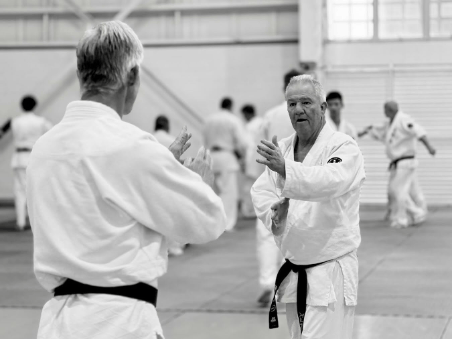
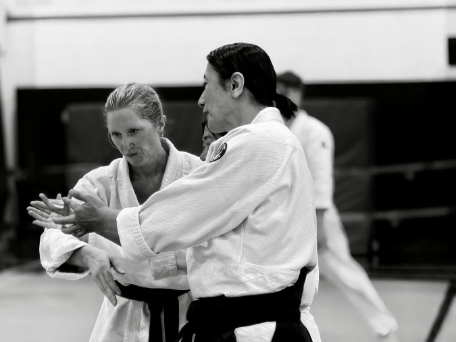
Session #2 kicked off after a 30-minute break. This session again started with Taisabaki (body evasion drills). Only this time we focused on Uraken (reverse fist turning strike). After the body movement drilling, we moved into a variation of defensive techniques against Uraken. Sensei then paired Kento with Uraken striking to progress the practice further. Session #2 finished with a few tired bodies, and we took a 2-hour lunch break to recharge.
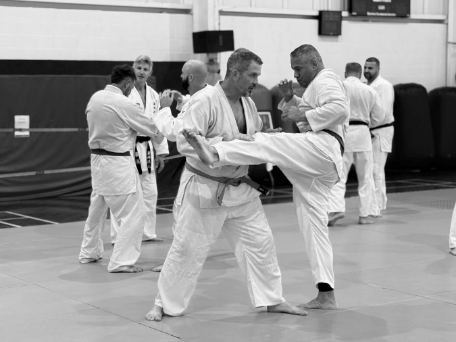
Session #3 kicked off with renewed vigor after a delicious roast pork lunch catered at the venue. Training consisted of the right-hand side of the GRAJJ Shite Waza Syllabus sheet now. Again, Sensei began with Taisabaki: Shomen Geri evasion drills. We then jumped into various Shomen Geri (front kick) defense techniques, from Iriminage (front entering throw) through to the guillotine choke Kubi Jime.
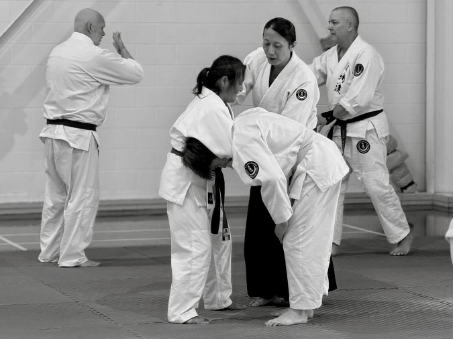
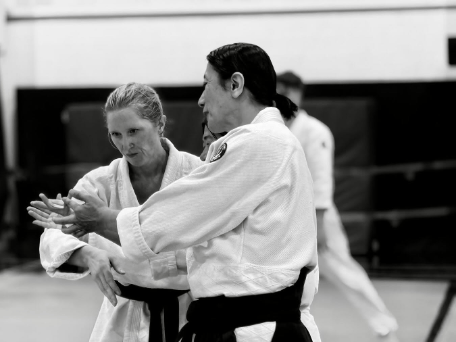
Sensei then moved the focus of the training forward again by building on what was just practiced by simply adding one familiar component to the current training: Shomen Geri became Kento Shomen Geri. Within this we trained various techniques like Ikkajo (first control submission principle), Hiji Otoshi (elbow drop) and Kokyu Nage (breath timing throw).
A small 30 min. break with afternoon tea and we were into Session #4, the final 1.5-hour session of the day. We began with Yokumen Geri Taisabaki (roundhouse kick body evasion) drills that set up the next series of techniques. Continuing on the right-hand side of the GRAJJ Shite Waza Syllabus sheet, we delved into Yokumen Geri defense techniques. It was particularly important to note how Sensei continuously came back to the Kihon Dosa (basic movements) as a reference point for developing power, connection and base; and in this case the basic movement Shumatsu Dosa provided the key to receiving the Yokumen Geri. Here we went on to practice Shihonage (all directional throw), Nikajo Osae (2nd control submission principle) and Sankajo Osae (3rd control submission principle). To finish the day, as per all the sessions for the day, we rounded out the session with Nage Waza (throwing techniques) line work. Although much less intense and with more instruction from Mori Sensei, the session – and the day to some degree – offered many students some insight into the ‘second classes’ at the Brisbane Dojo throughout the ‘golden years’ of the early 2000s where each session was tough: no slowing down at any time, running everywhere and always, no chances to rest other than if there was an uneven number on the mats and you made a group of 3. It was full throttle for 45 minutes straight! (Then, you backed up for 3rd class Jiu Waza Class where you were thrown by Mori Sensei until you couldn’t stand up anymore. Fun times!)
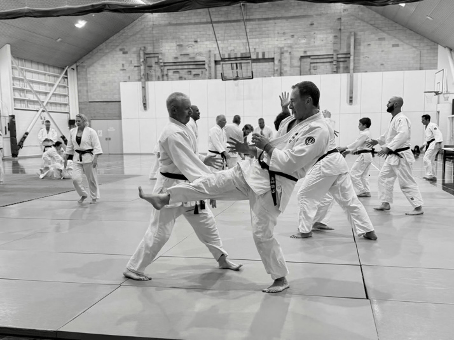
That evening after a scrumptious dinner (with seconds of Chocolate Brownie and Cream dessert; the food throughout the camp was plentiful and tasty ) those who stayed socialized with a few well-earned cold beers and some laughter. Day #1 was big and there was more waiting for us tomorrow. So most took an early mark and got a good night’s sleep to rest their tired bodies.
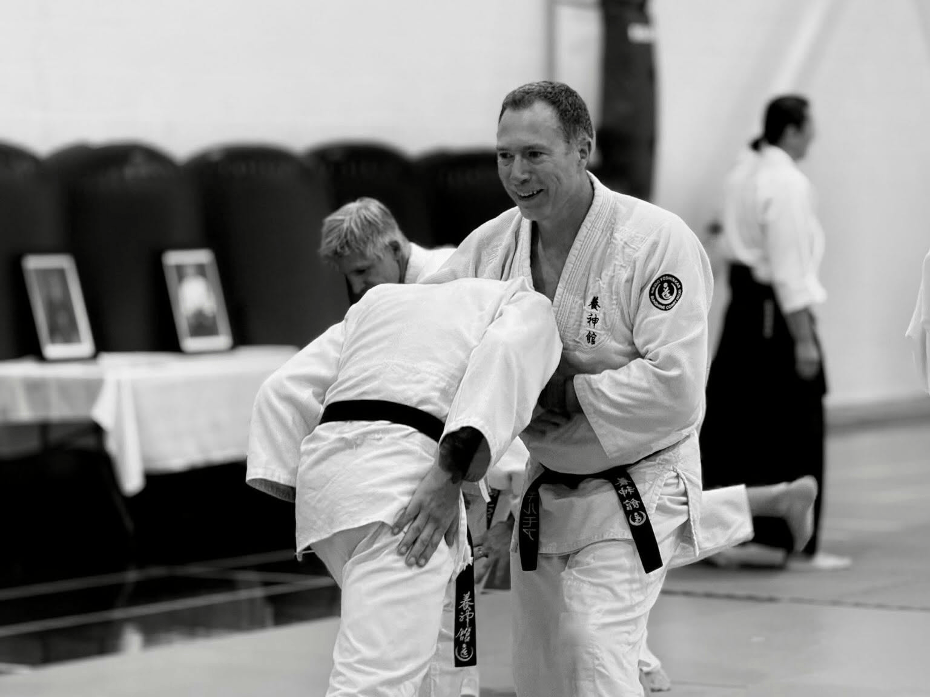
It was a great day and a wonderful evening!
DAY 2
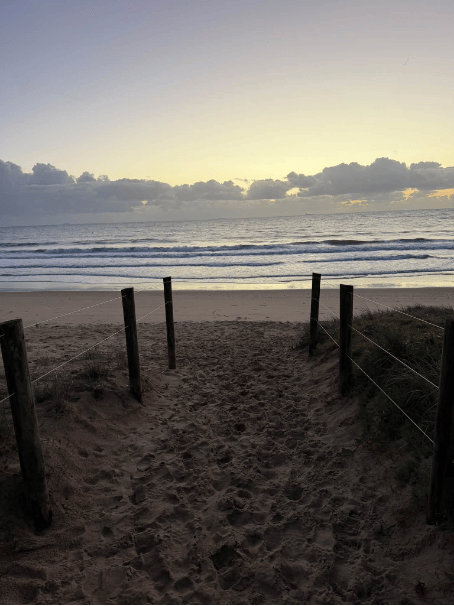
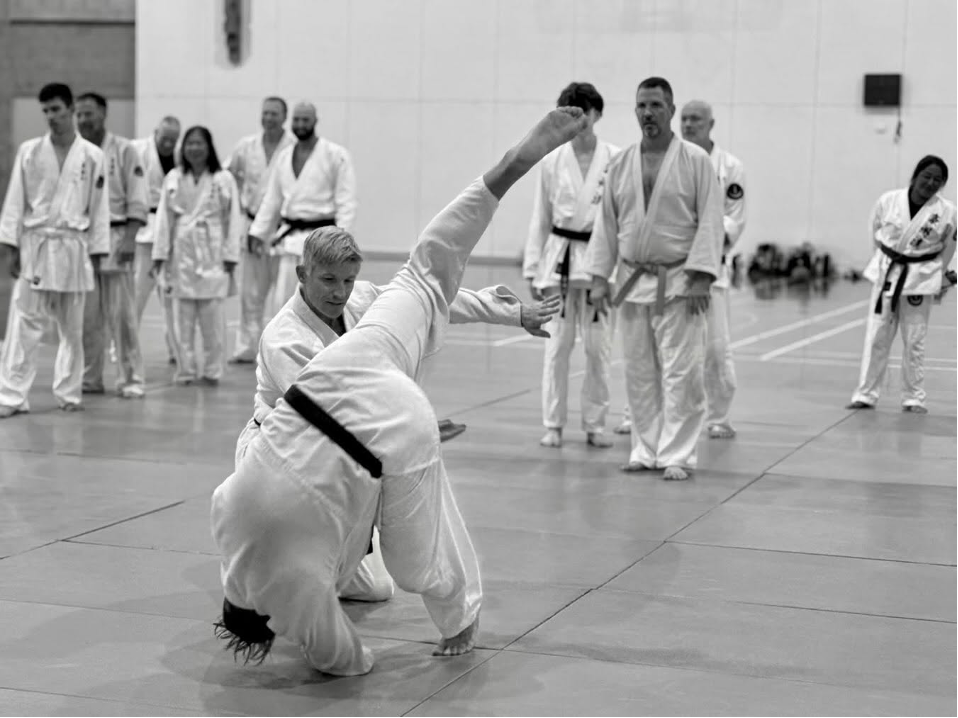
After the morning ritual at the beach at dawn (while everyone else was still sleeping 😉), just a small stroll from the cabins, we were into a nutritious and plentiful breakfast, and then back onto the mats by 8am for Day 2!
In Session #1 Sensei warmed up all the stiff bodies on the mats with striking – Kamae ni yoru atemi. Then Sensei took the Syllabus further to highlight the unlimited potential of it. He added the ‘Gyaku’ (reversed) element to each technique that exists within the current Syllabus to show how Shite can take the initiative in a situation that is getting out of hand and take control of Uke without waiting for the aggressor to attack. Here students were prompted to utilise the capacity of the Uraken and Kento gata strike to initiate the technique and finish the interaction quickly. Sensei liked to refer to these as applied techniques, many of which he has discussed with me that he taught to special forces in Australia, India and Japan in his earlier years. A key point to these techniques is the reduction of the circles within the techniques – not different, just tighter without room for escape. Another way of looking at it is that there is more and relentless pressure placed on Uke throughout the techniques. This often asks more of Uke in their ability to ukemi (self-preservation rolling). For example, in the case of the Shihonage that we practiced, the technique is more spiral-like without room for Uke to escape or do anything other than break-fall well to avoid hitting the ground hard or hurting their elbow and shoulder as they are taken down. It seems easy from the bystander perspective, but this is a false perception because of the degree of mastery Mori Sensei exhibits – you have nowhere to go but down hard!
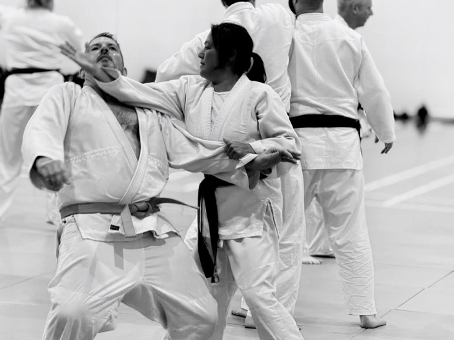
In this session Mori Sensei changed people’s perspective on and transformed many people’s understanding of some of our Kihon Waza (basic techniques/forms). Basic techniques such as Shihonage, Ikkajo, Nikajo Sokumen Iriminage, Ude Garami, Shomen Iriminage, and Kote Gaeshi to name just a few were practiced in this fashion.
I hope people walked away from this session with a clear understanding that, yes we practice the ‘form’ in regular classes (kata geiko), but these are just shapes in which we use as vehicles to develop Aiki principles and build an Aiki body that embodies these principles. Then, after many years of dedicated training with this, any movement becomes a technique. But don’t be mistaken in assuming that you can just start here without working hard for years on the basics. Otherwise, you will be like the thousands of other misguided and ignorant Aikidoka around the world and online who are under the false assumption that what they are doing is Aiki! If you subscribe to this idea, you too, like these many imposters, will have a long list of techniques that won’t work for you in any martial setting!
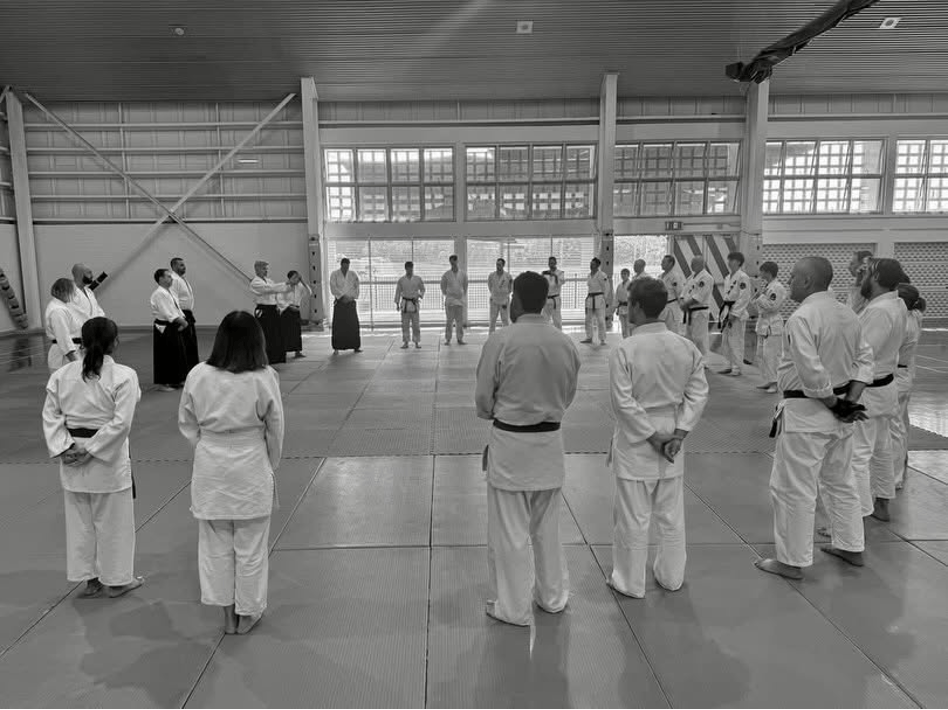
Session #2, the final training session for the weekend, kicked off with a strong focus on the power of the basic movement Hiriki no Yosei. Sensei emphasised how through a dedicated study of this movement, the key to Aiki Waza – through the principles of connection, leverage and base – can be found. In other words, Hiriki no Yosei is the key to amplifying all your techniques by understanding these principles and using them to lock Uke and either control or throw them. From this, Sensei taught everyone a range techniques relating to his Aiki Waza.
You may not be aware, but despite many ‘martial artists’ (and I use this term loosely) around the world espousing the ability to perform Aiki Waza techniques such as Mori Sensei does, there is actually only a hand-full of people globally who can legitimately do this (as for me, I might successfully perform Aiki Waza many times, but I too cannot do it to 100% of people 100% of the time – I have much more to practice and learn). Again however, there are a lot of imposters filling the internet untested. Rest assured that Mori Sensei’s Aiki is legit – I tested his Aiki Waza once by Sensei’s request… I tried to resist and not take ukemi to ‘see what happens’… I nearly speared into the mat with my head and broke my neck. I had to quickly roll out to save myself. It was a very insightful experience: Insight 1.: The absolute importance of ukemi for self-preservation, and Insight 2.: Sensei’s Aiki was without question, extremely effective, even more so when uke resists!
After lunch, senior Black Belts performed demonstrations, which finished with Mori Sensei’s demonstration to wrap up the weekend’s training. It was a nice way to finish a good weekend of Budo.
I sincerely hope that you all enjoyed watching (or if you were lucky enough to uke, participate) these! Don’t ever forget that taking Uke is the No.1 best way to learn a martial art and specifically your teacher’s technique; the nuances and principles behind every technique can only be transmitted physically, they can’t be transmitted verbally! And this is why there is no substitute for the mats, irrespective of what people might post online! There is no substitute for mat time!
And that was that! Done. A year of preparation and a weekend of wonderful training with good people! The 2026 GRAJJ Sunshine Coast Gasshuku came to a close.
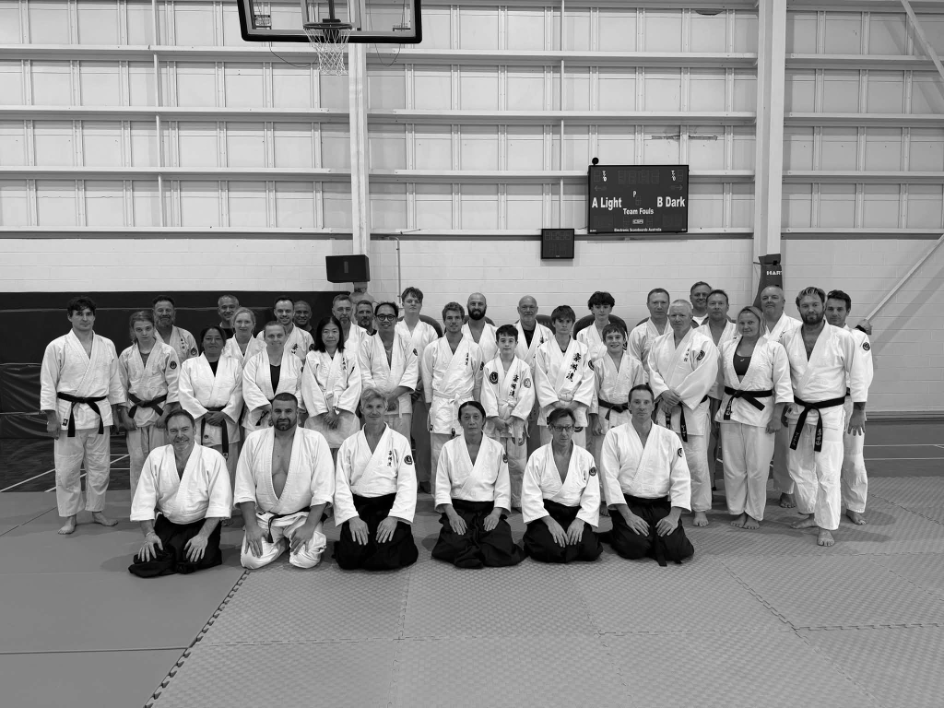
It was a real pleasure to welcome Mitchell Sensei with his students from the Northern Territory. I particularly enjoyed training with them and helping them to apply these techniques to their context: they are military and law enforcement workers, and they thoroughly enjoyed the practicality of our training! It’s always enjoyable working with police officers and providing insight into how effective our GRAJJ techniques are in law enforcement restraint and control. Thanks for coming and you are always welcome!
A big thank you to Steve Denning for the use of his trailer and his help both in setting up and packing down. It is always very much appreciated! Osu! 🙇🏻♂️ Thank you, Col, also for transporting the other half of the mats for the camp. Again, on behalf of Richard Sensei, we are very grateful! Thanks to Tomoko and Jan for aiding in the moving and setting up of the mats at the venue on the Friday afternoon – Thank you so much! 🙏 And lastly, thank you to the Sunshine Coast Dojo students who helped pack up and restore the mats back to the dojo on the Sunday afternoon. All of your help in all of this went a long way to making the weekend a success!
Lastly, you can find video footage of all the sessions from the weekend of training on our dojo YouTube Channel. Check it out to relive the weekend and/or revisit and revise some of the finer instruction shared graciously by Mori Sensei!
Osu!
Ryan Slavin


Leave a Reply